
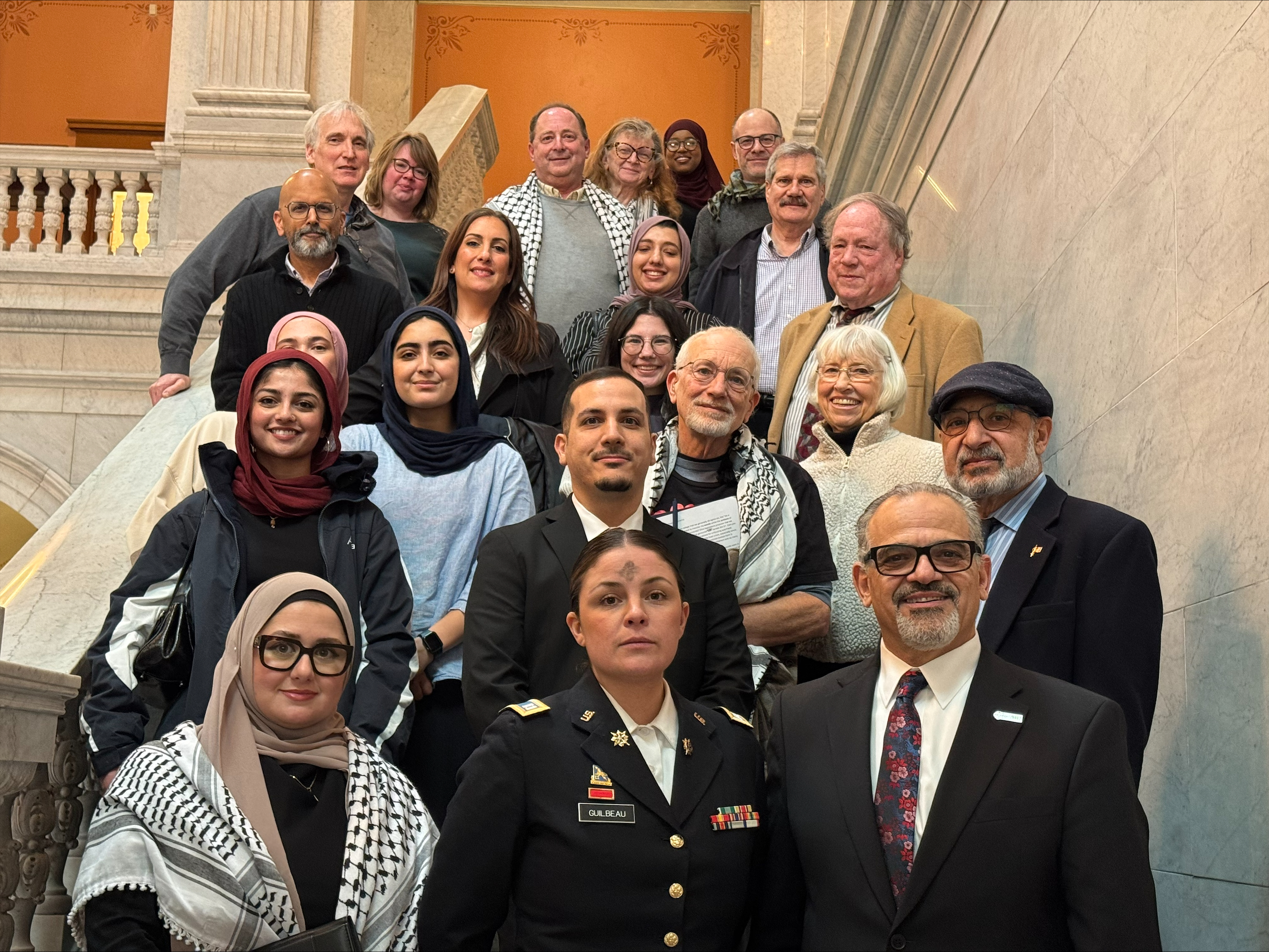
(Columbus, OH – 2/19/26) – The Ohio chapter of the Council on American-Islamic Relations (CAIR-Ohio), CAIR Action, the ACLU of Ohio, the Ohio Divest Coalition, and a diverse coalition of partners testified against Ohio Senate Bill 87 (SB 87), legislation that would codify the controversial IHRA definition of antisemitism into state law on Wednesday, Feb. 19.
The coalition included lawyers, doctors, educators, veterans, and faith leaders from Muslim, Jewish, Christian, and other communities. Together, the coalition members advocated for free speech and human rights for people of all backgrounds. More than 25 Ohioans from across the state testified against the bill in-person, in addition to more than 67 others submitting written testimony. A letter signed by more than 100 Jewish Ohioans opposing SB 87 was submitted to the Senate Judiciary Committee, and more than 400 Ohioans signed an action alert urging lawmakers to vote no.
If passed, SB87 would expand the net of criminalization for speech using the IHRA definition of antisemitism that has been widely criticized as overbroad. Even Kenneth Stern, the principal drafter of the definition, has opposed its use by government agencies.
SB 87’s targeted addition of riot and aggravated riot as qualifying offenses for the ethnic intimidation statute would provide justification for calling law enforcement on a group of five or more people if someone disagrees or dislikes the content of their lawful speech or expression.
At the hearing, many voiced concern about the risk this bill poses to free speech and the potential wasting of law enforcement time and resources it would cause.
CAIR Northern Ohio Executive Director Faten Odeh, stated:
“If this definition becomes law, individual law enforcement officers and agencies, as well as public institutions, will be left to interpret what qualifies as antisemitic on the ground amid conflicting stories. What happens when those interpretations differ? What happens when personal stories like mine are viewed through a political lens? What happens when criticism of a foreign government is treated as evidence of bias?
“Vague standards combined with criminal consequences create real risk. They open the door to uneven enforcement. They create the possibility that Ohioans will be investigated or penalized based on how their speech is perceived rather than whether they committed unlawful conduct. Ohio is home to many who care deeply about human rights. Many are already scrutinized for their activism and beliefs. SB 87 would force people to censor not only political expression but also personal testimony about their own lived experiences to avoid potential legal trouble.”
17-year U.S. Army veteran Captain Josephine Guilbeau stated:
“For nearly two decades, I believed I was defending freedom — including conscience, speech, and religious liberty. If this bill passes, those freedoms are at risk at home. No law you pass can silence the faithful. No statute can erase the Word of God from our hearts. If defending the right to worship, teach, and live by conscience brings persecution or even the threat of death, I stand ready, as thousands of saints and Christians have before me. As the early Christians declared, ‘We must obey God rather than men’ (Acts 5:29). We will not be silenced. Christians, Jews, and Muslims stand shoulder to shoulder in solidarity against the Zionist empire and the genocide in Gaza. For these reasons — as a veteran, a Catholic, and an American — I urge you to vote against Ohio Senate Bill 87 and defend the religious freedoms guaranteed by the Constitution.”
CAIR Action Policy & Advocacy Coordinator, Hoda Elahinia, stated:
“As Americans, we are protected when we criticize our own government. We are protected when we protest federal policy. We are protected when we speak out against war, foreign aid, or international actors. So I ask you plainly: why would Ohio move toward punishing speech when that speech involves criticism of a foreign government?”
Retired professor and member of Jewish Voice for Peace, David Shutkin, stated:
“My opposition to Zionism is political and ethical, not antisemitic. Critiquing a state’s ideology or policies—including claims that Israel’s founding structure is racist and discriminatory—is not hatred of Jews. Conflating such criticism with antisemitism weakens the fight against genuine antisemitism: hate crimes, conspiracy theories, and Holocaust denial.”
Lakewood resident Emily Kichler stated:
“As a Jew, I don’t want you to write legislation about protecting Israel on my behalf. I don’t want to be associated with a place that’s done so much harm, and yet I am tethered to it through my heritage, to the point that it is my duty to come and speak during moments such as these to expose why these ties are holding everyone back. I want us to all let go of them.”
A similar bill, SB297, was stopped by organizers in 2024.
CAIR is America’s largest Muslim civil liberties and advocacy organization. Its mission is to enhance understanding of Islam, protect civil rights, promote justice, and empower American Muslims.
La misión de CAIR es proteger las libertades civiles, mejorar la comprensión del Islam, promover la justicia, y empoderar a los musulmanes en los Estados Unidos.
Become a Fan of the Cleveland chapter of CAIR-Ohio on Facebook
https://www.facebook.com/CAIRCleveland
Subscribe to the Cleveland chapter of CAIR-Ohio’s YouTube Channel
https://www.youtube.com/@caircleveland
Follow the Cleveland chapter of CAIR-Ohio on Instagram
https://www.instagram.com/cairohiocleveland/
Follow CAIR Action Midwest on Instagram: https://www.instagram.com/cairactionmw/
Follow CAIR Action Midwest on Facebook: https://www.facebook.com/profile.php?id=61561986031598
CAIR Action Website: https://cairaction.org/
END
CONTACTS:
CAIR-OH Executive Director, Northern Ohio, Faten Husni Odeh (216) 830-2247, fodeh@cair.com
CAIR Action Ohio Policy and Advocacy Coordinator, Hoda Elahinia (419) 318-9481, helahinia@cairaction.org